

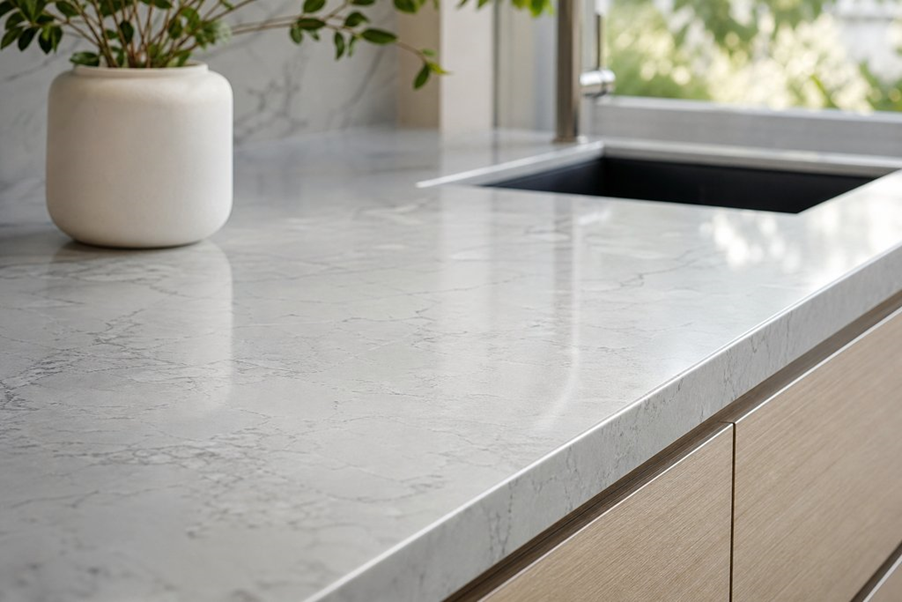
Quartz kitchen countertops
Quartz has become a go-to choice for busy Davie homeowners looking for durable, low-maintenance counters. But before committing, it’s important to understand quartz countertop limitations.
The Practical Limits of Quartz Countertops
Quartz is a very durable and beautiful countertop material. The crushed mineral particles are mixed with pigments and resins, then compressed to create a very dense and non-porous material. Quartz countertops are hard-wearing and don’t need sealing. But there are quartz countertop limitations, something CNET walks through at www.cnet.com/home/kitchen-and-household/quartz-vs-granite-countertops-which-is-better, to keep in mind before choosing this material:
- Quartz can discolor, mark, or crack from intense heat. Always use trivets under hot cookware. Quartz isn’t suited to outdoor kitchens either.
- Intense, sustained UV can discolor quartz countertops.
- Quartz is very heavy and inflexible. Cabinets need to be sturdy and structurally sound, and long overhangs might need supports.
- Larger rooms might need more than one slab, and seams may be difficult to conceal on bold quartz countertop colors and designs.
- Dropped pots and pans can chip quartz countertops, particularly at the edges.
Why Do Heat and Sunlight Cause Problems?
Because of its resins, quartz is vulnerable to extreme heat. Leaving a hot roasting pan or skillet on quartz can leave a mark, cause discoloration, or create a crack. This risk increases if the heat is focused on a smaller area. For example, quartz can handle high-heat cooking if the cooktop isn’t right up against a wall. But if your cooktop is positioned between two walls or a range or wall ovens sit close to a sunny door, heat will have nowhere else to go; the practical side of where quartz countertops have limits in Davie starts there.
For this reason, always set hot items on trivets or other heat-resistant pads. And, though quartz holds up well to everyday wear-and-tear, always lift and carry items that could be very hot. This includes:
- Cookware coming out of the oven or off the stovetop
- Electric cookware like slow cookers, air fryers, toaster ovens, pressure cookers, and griddles
- Small appliances that generate intense heat like coffee machines and kettles that release lots of steam
Just like intense heat, intense UV can affect quartz. If a slab is exposed to intense, sustained UV from South Florida’s strong sunshine, it can start to change color. Slabs can discolor unevenly or turn yellowish. Solid colors are the most susceptible to fading. Bold colors are particularly vulnerable, including stark white and very dark slabs.
Covered patios aren’t necessarily ruled out. Just ensure the slab gets very little direct sunshine. But even in covered areas, reflected heat can make countertops extremely hot. Glass doors, pool decking, or pale-colored walls can intensify the problem. Window coverings and UV-blocking windows can help, as can large eaves or patio overhangs that shade countertops. Quartz can’t go in an outdoor kitchen, though, or in areas that see lots of South Florida sunshine.
Support and Seams Shape the Installation
Supported quartz countertop installation
Quartz is rigid. And it’s very dense and heavy. It will buckle and break if asked to bend to span large open areas. Quartz needs sturdy, stable bases that are built to be structurally sound.
For instance, many people want quartz countertops to extend over breakfast bars for extra seating. But a fabricator will need to assess how far your counters will overhang and how thick your quartz is. If necessary, the quartz may need to be reinforced with concealed brackets and supports.
Larger kitchens and huge islands may not fit on one big slab. Narrow doorways, staircases, and winding routes into rooms can complicate the delivery of large pieces too. In these cases, fabricators have to join smaller slabs and create seams. A skilled team can make seams inconspicuous, particularly if they’re well away from busy preparation areas. But a seam is never completely invisible. They’re most noticeable on busy countertops and bold slabs, including:
- Busy, intricately veined slabs with lots of detail
- Stark white slabs without any veining or busy patterns to disguise joins
- Deeply hued slabs in dark colors like charcoal and black
Edges and Cutouts Remain Vulnerable
Quartz is a tough countertop that stands up to scratches and scuff marks. But the edges are vulnerable to chipping from sharp, strong impacts. Narrow gaps around sinks or appliances are vulnerable to chipping too. Cast-iron skillets or pans dropped onto counters can crack or chip quartz. Walking into an island’s corners can chip them too. Some edge styles are more likely to show chips, particularly square-edged countertops. Slab edges that are eased or rounded can disguise chips. Cracks can happen if cabinets aren’t level and sturdy or if they settle post-installation and put pressure on the rigid, dense countertops.
The non-porous nature of quartz makes it resistant to everyday spills. However, highly alkaline cleaners such as oven cleaner and paint stripper can dull the finish or even affect the resin binder if left on the surface. Concentrated bleach can have the same effect, and abrasive pads should be avoided as they will reduce the polished look.
Wipe up spills as soon as possible, particularly oil, dye and permanent ink. Use a soft cloth, warm water and a mild cleaner for routine cleaning.
Cabinet Decisions Come Before Templating
Countertops are measured and templated once cabinets are in situ and fixed and leveled. If you want to change anything after templating is done, this can delay your quartz countertops. Changing the size and position of cabinets, the size or position of built-in appliances, and sink and faucet designs can impact countertops and mean they have to be remade. Before your counters are templated, be sure you’ve made decisions about:
- The design, size, and position of any sinks
- Sink bowls that sit under counters, especially if they’re integrated with the quartz
- The height of any backsplashes
- The size and position of built-in cooktops
- How far your countertops should overhang for seating
- How much space you need to clear cabinet pulls
- The material, design, and construction of end panels around refrigerators, dishwashers, and other tall, freestanding appliances
Come to your templating and measuring appointment with samples of quartz, final cabinet designs, and the details of any built-in appliances.