

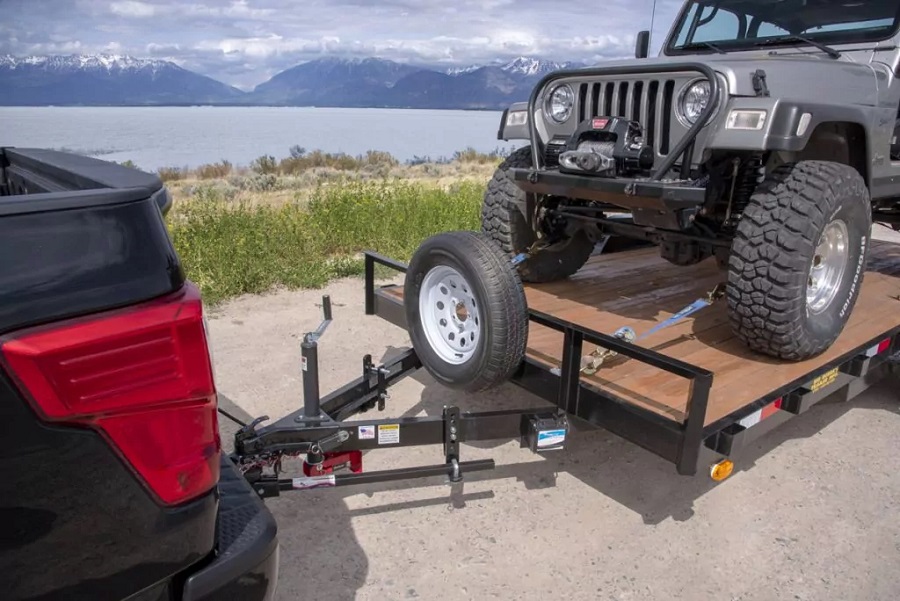
Few experiences behind the wheel induce panic faster than glancing in your side mirror and watching your trailer step out of line, oscillating back and forth across the lane. At low speeds, a slight wiggle is merely unnerving. At highway speeds, that same oscillation can turn violent within two seconds, transforming thousands of pounds of rolling steel into a runaway pendulum that can drag your tow vehicle across multiple lanes or flip it entirely.
Trailer sway, commonly called fishtailing, is responsible for some of the most catastrophic towing accidents on American highways. The good news is that sway is not an unavoidable act of nature or bad luck. It is a predictable result of physics, and with the right preparation, proper hardware, and a clear understanding of vehicle dynamics, you can prevent it completely.
The Anatomy of Trailer Sway
Every bumper-pull trailer connected to a hitch ball acts as a pivot point. When your tow vehicle turns, hits a bump, or catches a blast of wind, the trailer pivots slightly behind it. Under normal conditions, friction and tire grip dampen that movement, pulling the trailer back into a straight line directly behind the vehicle.
Instability occurs when the forces acting on the trailer overcome the tires’ ability to self-correct. When an oscillation is not dampened, it begins to feed on its own momentum, growing wider and more aggressive with each swing. This phenomenon is known as dynamic instability. Once the trailer enters this cycle, the lateral forces transferred through the hitch can overwhelm the traction of the tow vehicle’s rear tires. When the rear of the truck breaks loose, the entire rig enters an uncontrollable jackknife.
Preventing this chain reaction requires eliminating the conditions that allow small wiggles to amplify into violent swings.
The Foundation: Tongue Weight and Load Distribution
The single most frequent cause of dangerous trailer sway is improper cargo placement. In a bumper-pull setup, the trailer’s center of gravity must sit forward of its axle or axle cluster. If that weight shifts too far back, stability evaporates.
For safe towing, tongue weight should always measure between 10% and 15% of the total loaded trailer weight. For example, if your travel trailer or utility trailer weighs 6,000 pounds fully loaded, the downward force resting directly on your hitch ball must fall between 600 and 900 pounds.
The 60/40 Rule
When loading cargo, place approximately 60% of the total cargo weight in the front half of the trailer, ahead of the axle, and distribute the remaining 40% evenly behind it. Keep the heaviest items as low to the floor and as close to the trailer centerline as possible.
When beginners load heavy equipment, firewood, water tanks, or motorcycles at the extreme rear of the trailer, they create a lever that physically unweights the hitch ball. This creates a high polar moment of inertia. The rear end acts like a heavy pendulum bob; the moment wind or a passing vehicle initiates a turn, that concentrated rear weight swings outward with tremendous force, pulling the tow vehicle along with it.
Verifying Your Weight
Never gauge tongue weight by eye. Modern pickup trucks with heavy suspension packages may show very little rear-end sag even when tongue weight is dangerously low, while half-ton trucks or SUVs with coil springs may sag significantly under normal loads. Use a specialized hydraulic tongue weight scale in your driveway, or take your loaded rig to a local commercial truck scale (such as a CAT scale). Comparing your tow vehicle’s axle weights with and without the trailer attached gives you exact figures for total trailer weight and tongue weight.
Upgrading Your Towing Hardware
While proper load distribution establishes baseline stability, mechanical aids provide essential margins of safety on unpredictable roads.
Weight Distribution Hitches
A standard weight-carrying hitch transfers all tongue weight directly downward onto the tow vehicle’s rear axle. Because the rear axle acts as a fulcrum, heavy downward force pushes down on the rear while lifting up on the front axle. This unweights your front tires, leading to floaty steering, reduced braking performance, and headlight glare pointed into the trees.
A weight distribution hitch uses rigid spring bars hooked under tension to lever that weight forward onto the tow vehicle’s front steer axle and backward onto the trailer axles. Restoring front-axle weight returns normal steering control and keeps your tow vehicle level.
Dedicated Sway Control Systems
Weight distribution levels the load, but dedicated sway control dampens side-to-side rotation. Basic setups use a friction bar clamped between the hitch head and the trailer frame, resisting movement through mechanical friction.
More advanced setups feature integrated sway control built directly into the weight distribution brackets using friction pads or dual-cam locks. These systems constantly resist minor lateral deflections while still allowing the hitch head to articulate smoothly during tight parking maneuvers and normal cornering.
External Triggers: Bow Waves, Crosswinds, and Speed
Even a perfectly balanced rig experiences external lateral forces. Understanding when and where these forces strike helps you anticipate them before they disrupt your vehicle.
Large commercial semi-trucks push a substantial bow wave of high-pressure air forward and outward from their front grilles. As a semi passes your rig, that bow wave hits the rear of your trailer first, pushing your trailer toward the shoulder and angling the front of your truck inward toward the semi. A second later, as the semi pulls ahead, the low-pressure suction zone trailing behind its cab pulls your trailer inward, pushing your truck away. Recognizing this two-stage push-pull effect allows you to keep a firm grip on the wheel and maintain your line without overreacting.
Crosswinds off open plains, bridge crossings, and sudden gaps between highway tree lines can also induce sudden lateral deflection.
The most controllable factor of all is your vehicle speed. Every towing setup has a critical speed threshold where stability begins to degrade exponentially. Towing at 75 mph leaves virtually zero margin for error if an unexpected gust hits you. Keeping your cruising speed between 55 and 62 mph dramatically reduces aerodynamic drag, keeps trailer tires within their designated heat thresholds, and keeps your rig far below its critical sway velocity.
What Never to Do When Sway Strikes
When a trailer begins swinging violently, normal driving instincts will tell you to do two things that make the situation drastically worse: slamming on the vehicle brakes and counter-steering.
Slamming on your tow vehicle’s brake pedal transfers vehicle weight to the front wheels and violently unloads the rear tires. At that exact moment, the swinging trailer is whipping against the rear bumper with maximum lateral force. The trailer’s forward momentum pushes hard against an unweighted, decelerating rear end, almost instantly triggering a jackknife.
Counter-steering is equally hazardous. The human nervous system cannot process and react quickly enough to match the oscillation cycle of a multi-ton trailer. In almost every case, a driver trying to steer out of sway ends up turning the wheel out of phase with the trailer’s swing, actively amplifying the harmonic motion until the trailer overturns.
The Correct Recovery Procedure: The Manual Override Protocol
If your trailer begins to sway at speed, follow this exact sequence to regain control smoothly:
First, keep the steering wheel firm and pointed straight ahead. Do not turn the wheel back and forth to chase the trailer. Hold your line down the center of the lane.
Second, take your foot completely off the accelerator pedal. Allow the vehicle to slow down gradually through rolling resistance and aerodynamic drag. Do not touch the foot brake.
Third, manually activate your trailer brake controller. Reach down and squeeze the manual slider lever on your electronic brake controller.
Activating the trailer brakes independently of the tow vehicle creates immediate tension across the entire rig. The dragging trailer acts like a parachute deployed behind a race car, pulling the hitch tight and snapping the trailer back into a straight line directly behind your vehicle.
Once the trailer pulls straight and your speed drops below the threshold where the sway began, check your mirrors, smoothly signal, and pull off onto a wide shoulder to inspect your cargo and hitch hardware.
Pre-Departure Checks That Guarantee Stability
Preventing sway begins before your vehicle ever pulls out of the driveway. Run through this pre-trip inspection before every tow:
Check all tire pressures on both the tow vehicle and the trailer using a reliable gauge. Trailer tires should almost always be inflated to their maximum cold PSI listed on the tire placard. Underinflated trailer tires feature soft, flexible sidewalls that amplify lateral roll and encourage sway.
Verify that your hitch ball matches your coupler size exactly (a 2-inch ball inside a 2-5/16-inch coupler will cause catastrophic detachment). Ensure the coupler latch is fully down and secured with a locking pin.
Cross your safety chains underneath the trailer tongue in an “X” pattern. If the coupler ever comes off the ball, crossed chains create a supportive hammock that catches the falling tongue before it digs into the asphalt.
Confirm that the emergency breakaway cable is attached directly to the tow vehicle frame, not wrapped around the hitch safety chains, so the pin pulls cleanly if the trailer completely separates.
Finally, secure all cargo inside the trailer with heavy-duty ratchet straps. An unsecured refrigerator, tool chest, or crate of supplies that shifts from the front of the trailer to the rear bumper during a sudden stop can turn a rock-solid, well-balanced setup into an unstable hazard thirty miles down the road.
Towing a trailer safely requires deliberate setup and a clear understanding of dynamic forces. When you balance your tongue weight correctly, equip the vehicle with proper sway-control hardware, and manage your highway speed, you eliminate sway before it has a chance to begin.