

Broad shoulders are one of the most coveted structural features in modern fashion. From sharp haute couture tailoring to classic red carpet gowns, a strong shoulder line provides an enviable architectural hanger that makes clothing drape with authority. Yet for many women with athletic, inverted-triangle, or naturally broad frames, dressing the upper body can feel like an ongoing struggle against unwanted boxiness. When a garment cuts straight across the clavicle or adds bulk to the wrong points, it can easily make the torso look top-heavy and stiff.
Styling broad shoulders is never about hiding your frame or trying to shrink yourself. It is entirely about mastering visual proportion and optical direction. The human eye naturally follows lines, boundaries, and contrasts. By understanding how different necklines direct the gaze, you can soften angular edges, elongate your neck, and create effortless harmony across your entire silhouette.
The Geometry of Visual Balance
To understand why certain tops flatter broad shoulders while others feel restrictive, you have to look at how lines operate on the body. A neckline is not just an opening for your head; it is a graphic frame that tells the viewer where to look.
Horizontal lines encourage the eye to scan from left to right. When a collar runs straight from shoulder tip to shoulder tip, it visually measures and emphasizes the widest horizontal plane of your upper body.
Vertical and diagonal lines, on the other hand, force the eye to travel upward and downward. They create an optical break in broad horizontal expanses, drawing attention toward the center of your chest, down toward your waist, and upward toward your face. When you disrupt a broad horizontal line with vertical or angled negative space, you instantly soften the perceived width of your shoulders without losing any of their statuesque presence.
The Most Flattering Necklines for Broad Frames
When your goal is balance, you want necklines that carve into the upper torso and draw the focal point inward. Several classic cuts excel at creating this visual ease.
The Classic V-Neck
The V-neck is the undisputed workhorse for balancing strong shoulders. By dipping down toward the sternum, a V-neck introduces two sharp diagonal lines that converge at a central point. This creates an optical downward arrow that splits the upper chest into distinct, narrower sections.
The depth and width of the V matter. A narrow, moderate-to-deep V-neck works significantly better than a wide, shallow one. A shallow V that spreads out toward the shoulder joints still reads as a horizontal band, whereas a deeper cut pulls the gaze down into the core of your frame, lengthening both the neck and torso.
The Deep Scoop and Oval Neck
If you prefer rounded lines to sharp angles, a deep scoop neck is an exceptional choice. Angular shoulders often feature pronounced bone structure, and the gentle curve of a scoop introduces an organic softness that counters rigid shoulder lines.
Much like the V-neck, depth is essential here. Look for scoop necks that fall a few inches below the collarbone rather than sitting right at the throat. An elongated, open scoop exposes the décolletage, turning skin into negative space that breaks up the continuous fabric plane across your chest.
Asymmetrical and One-Shoulder Cuts
Asymmetry is an understated secret weapon for broad frames. When a neckline cuts diagonally from one shoulder down across the chest—such as in a classic one-shoulder top or an asymmetrical drape—it breaks the visual mirror image of your shoulders.
Because the eye cannot scan both shoulders at the same time in a clean horizontal line, it follows the slant of the fabric instead. This diagonal motion prevents anyone from registering the total span of your upper body, lending an avant-garde, fluid elegance to your outfit.
The Inverted Halter
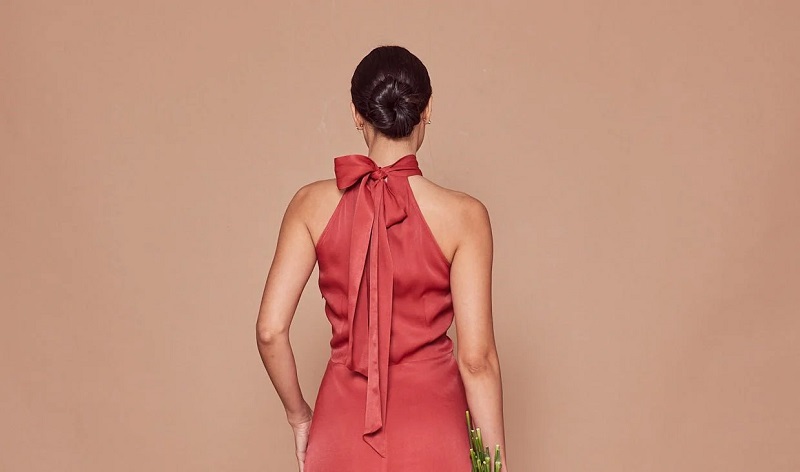
Many people with broad shoulders mistakenly avoid halter tops, fearing that exposing the shoulder caps will make them appear larger. In reality, a high-neck, cut-away halter is remarkably flattering.
An inverted halter cuts inward toward the neck base, exposing the outer curves of the shoulders while covering the central chest. By drawing the visual boundaries inward toward your throat, the cut emphasizes the curve of the shoulder rather than its horizontal width. It frames strong shoulders as an athletic asset rather than an awkward line.
The Wrap and Surplice Front
Wrap tops and faux-wrap dresses provide a dynamic diagonal crossover that mimics the benefits of a deep V-neck while offering structural flexibility. The overlapping fabric creates a diagonal seam that sweeps across the torso and anchors at the waistline. This diagonal movement effortlessly guides the gaze from the broad upper frame straight down to the narrowest portion of the midsection, cultivating a balanced hourglass proportion.
Necklines to Approach with Caution
Not all necklines serve a broad frame equally. Styles that construct an unbroken horizontal line or place heavy volume directly over the shoulder joints tend to exaggerate upper-body width.
The Boat Neck (Bateau)
The boat neck runs in a shallow, nearly straight line from the tip of one collarbone to the tip of the other. Because it mirrors the exact horizontal span of your shoulders, it operates as a visual measuring tape across your frame. Unless paired with a very full, voluminous skirt that rebalances the lower half, a boat neck will almost always make shoulders look wider and squarer.
Off-the-Shoulder and Bardot Styles
Off-the-shoulder tops sit in a direct horizontal ring that wraps around the arms and chest at the widest point of the torso. This band creates a shelf-like effect that amplifies breadth. If you love the romantic feel of an off-the-shoulder look, opt for a cold-shoulder top or a style featuring a draped, asymmetrical drop rather than a rigid horizontal elastic band.
Square Necklines
While square necklines are fashionable and structural, wide square cuts construct right angles that echo and reinforce square shoulder lines. If you choose a square neck, ensure it is cut relatively narrow and deep rather than wide and shallow, preventing it from framing the outer edge of your clavicle.
High, Unbroken Crew Necks
A standard, tight crew neck creates a high wall of solid fabric from the chin down to the chest. Without any open skin or diagonal seams to break up the surface area, the entire upper body reads as one broad, uninterrupted block. If you wear high crew cuts or fitted turtlenecks, layer them under an open jacket, cardigan, or long pendant necklace to reintroduce vertical division.
The Role of Straps, Sleeves, and Fabrics
A neckline does not operate in isolation; the surrounding construction elements either support or undermine its impact.
Pay close attention to strap width. Ultra-thin spaghetti straps create a stark contrast against a broad expanse of shoulder, which inadvertently makes the shoulder look wider by comparison. Medium to wide straps (roughly two to three inches wide) sit closer to the shoulder’s center, breaking the span into smaller, more balanced segments.
Sleeve placement also plays a pivotal role:
-
Raglan and dolman sleeves eliminate hard shoulder seams altogether, allowing fabric to slope naturally without defining the joint.
-
Set-in sleeves should sit precisely at your natural shoulder point; sleeves that drop off the shoulder bone can add unwanted boxiness.
-
Puff and cap sleeves should be handled thoughtfully. A stiff cap sleeve functions like an arrow pointing outward, while an exaggerated puff can push width past natural boundaries.
Finally, lean toward fabrics with fluid drape. Stiff, heavy fabrics hold their own rigid shape, transforming a shirt into a box. Soft silks, fluid jerseys, modal knits, and lightweight linens collapse gently against your frame, following your natural movement rather than building artificial structure.
Grounding the Silhouette from the Waist Down
True balance requires looking at your outfit as a unified composition. If you wear a top that celebrates your broad shoulders, you can complete the visual harmony by introducing conscious volume to your lower half.
Pairing a fitted V-neck or halter with wide-leg trousers, flared denim, pleated palazzos, or an A-line skirt creates an immediate counterbalance. Widening the hem of your pants or skirt matches the natural width of your shoulders, carving out your waistline in the middle and producing a timeless, proportional silhouette.
Broad shoulders give clothing presence, strength, and poise. When you use intentional necklines that break horizontal expanses and invite vertical movement, you transform that natural structure into your greatest stylistic asset.